


Summary:
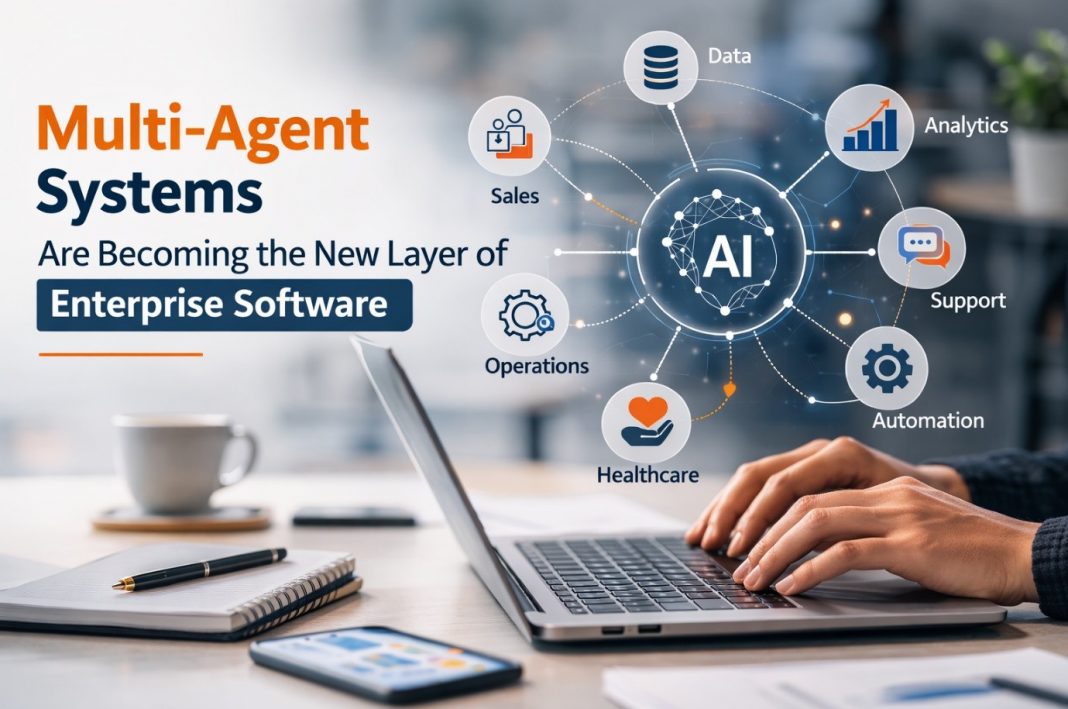
Multi-agent systems are changing enterprise software by allowing multiple AI agents to work together across tasks, decisions, and workflows. Instead of relying on one assistant for everything, businesses can use specialized agents to improve coordination, speed up operations, and handle complex work with better accuracy and control.
Introduction
Enterprise software is entering a new phase.
For years, businesses bought systems that stored records, ran workflows, and surfaced dashboards. Now they want software that can reason across tasks, coordinate actions, and move work forward with less manual effort. That shift is why multi-agent systems are getting serious attention.
Microsoft has already introduced multi-agent orchestration in Copilot Studio, while AWS and Anthropic have published guidance and tooling around agent-based and multi-agent workflows.
That alone says a lot. This is moving from concept to product layer.
What multi-agent systems mean in practice
A multi-agent system uses several AI agents that work together instead of relying on one large assistant to do everything.
Each agent handles a defined role. One may collect information. Another may validate inputs. A third may draft an answer or trigger an action inside a system. An orchestrator or supervisor agent manages the flow, routes tasks, and keeps the work aligned with the end goal.
AWS describes this model as specialized agents working under the coordination of a supervisor agent, while Microsoft outlines orchestration patterns such as sequential, concurrent, and handoff flows.
That sounds technical, but the idea is fairly simple.
In an enterprise setting, work rarely happens in one straight line. A customer request may involve sales data, pricing rules, compliance checks, contract review, and approval logic. One assistant can help, but a team of specialized agents can often handle that chain more cleanly.
Why enterprises are moving in the direction of multi-agent systems?
The rise of multi-agent systems is tied to a real software problem. Most enterprise work is cross-functional, repetitive in parts, and full of dependencies. Teams switch between CRMs, ERP systems, service desks, shared drives, email, analytics tools, and collaboration platforms just to finish one task.
This creates four common bottlenecks:
- Context gets lost between teams and tools
- Work waits for handoffs and approvals
- Manual review eats up time
- Valuable data stays trapped in separate systems
Multi-agent systems help because they can divide work by skill, keep context moving, and operate across tools.
Microsoft has framed this as agents working together as a team with human oversight, while Anthropic’s work on multi-agent research systems highlights how parallel agents can improve performance on more complex tasks.
Where multi-agent systems fit inside enterprise software
This is where the topic becomes more useful for business readers. Multi-agent systems are not just an AI feature. They are becoming a coordination layer inside enterprise applications.
1. Customer support and service operations
A service workflow may involve one agent reading the incoming issue, another checking account history, another searching knowledge sources, and another drafting the response for human review. This reduces handling time and keeps answers more grounded in actual customer and system context.
In a more mature setup, an agent can also open tickets, suggest next steps, or pull in the correct department automatically.
2. Sales operations and revenue workflows
Revenue teams often work across messy workflows. Lead qualification, proposal generation, pricing review, contract checks, and follow-up sequences all involve different systems and people.
A multi-agent model can support this by assigning clear jobs:
- A research agent gathers account intelligence
- A qualification agent scores fit and intent
- A pricing agent checks policies
- A drafting agent prepares proposals or emails
- A compliance agent flags risk
That means fewer delays and better continuity across the funnel.
3. Healthcare Workflow Automation
Healthcare is one of the clearest examples of where multi-agent systems can create real business value. Care delivery and operations depend on connected workflows across intake, documentation, scheduling, prior authorization, billing, compliance, and patient engagement. A healthcare workflow automation platform built on multi-agent logic can assign these responsibilities to specialized AI agents that work together while keeping human teams in control.
This is where platforms like Caregence become relevant. In a healthcare setting, one agent can collect and validate patient data, another can support documentation workflows, another can track prior authorization status, and another can assist with revenue cycle or staffing coordination.
Instead of treating each step as an isolated task, the platform helps connect them into a more responsive operational flow. That makes multi-agent systems in healthcare highly relevant for those interested in AI in healthcare, agentic AI in healthcare, care coordination automation, and enterprise workflow orchestration where speed, accuracy, and continuity matter every day.
4. IT operations and internal support
This is one of the most practical areas for adoption. Internal support requests usually require triage, lookup, verification, approval, and execution. A multi-agent workflow can classify the issue, check device or identity data, recommend a fix, and send a request for approval where needed.
The value here is speed, but also consistency. Similar requests can follow similar paths without depending fully on who happens to be online.
5. Finance and compliance processes
Finance work often carries heavy review logic. Invoice handling, policy enforcement, fraud checks, audit preparation, and vendor validation all benefit from specialized agents with narrow scopes.
One agent can extract fields, another can validate against rules, another can compare against contracts, and another can summarize exceptions for a reviewer. The result is a tighter process and clearer traceability.
What makes multi-agent systems different from earlier automation
Traditional automation follows fixed rules. It works well when the path is stable and predictable. Enterprise work often is not. Inputs vary. Exceptions appear. Data quality changes. Someone needs judgment.
Multi-agent systems bring a more adaptive layer to that environment. Each agent can focus on a bounded responsibility while still contributing to a larger business task. That setup mirrors how real teams work. There is role clarity, coordination, escalation, and review.
Anthropic has also noted that many strong agent implementations come from simple, composable patterns rather than overly complex stacks. That matters for enterprises because success often depends more on clean architecture and grounded workflows than flashy demos.
What enterprises need to get right
Interest is rising, but deployment quality will decide whether this becomes useful software or just another wave of pilot fatigue.
A strong enterprise multi-agent system usually needs:
| Area | What matters |
| Role design | Each agent should have a clear job and boundary |
| Orchestration | A supervisor or routing layer should manage task flow |
| Tool access | Agents need controlled access to business systems and data |
| Memory and context | The right context should move with the workflow |
| Human review | High-impact actions need checkpoints |
| Governance | Logging, permissions, and audit trails should be built in |
This is where enterprise software vendors are heading. Microsoft is formalizing orchestration patterns and open connectivity, and AWS is pushing multi-agent collaboration for complex workflows. These are signs of a broader architectural change, not isolated experiments.
What this means for software teams and business leaders
Software teams should stop thinking of AI as one assistant box sitting on top of a product. The larger opportunity sits in workflow coordination. When agents can delegate, verify, summarize, and act across systems, software starts behaving less like a static tool and more like an active operational layer.
Business leaders should also be realistic. Multi-agent systems are useful where work is complex enough to need specialization but structured enough to support guardrails. They are strongest in environments with repeated processes, defined responsibilities, and measurable outcomes.
Enterprise software is moving from record systems to response systems. Multi-agent architecture fits that change because it handles real work in a way that feels closer to how organizations operate.
Final takeaway
Multi-agent systems are becoming the new layer of enterprise software because they address a problem older software never fully solved: how to coordinate complex work across people, tools, data, and decisions. Instead of forcing everything through one assistant or one workflow engine, enterprises can use specialized agents that collaborate with purpose.
The result is better continuity, faster execution, and a more capable software stack. As major platforms continue building orchestration frameworks and multi-agent tooling, this approach is likely to become a standard part of enterprise application design.
Author Bio:
Sweta Parekh is the COO of Inferenz, where she helps shape AI-led solutions for healthcare transformation. With 18+ years of experience across product engineering and innovation, she brings deep leadership across healthcare, IoT, data, and AI.