

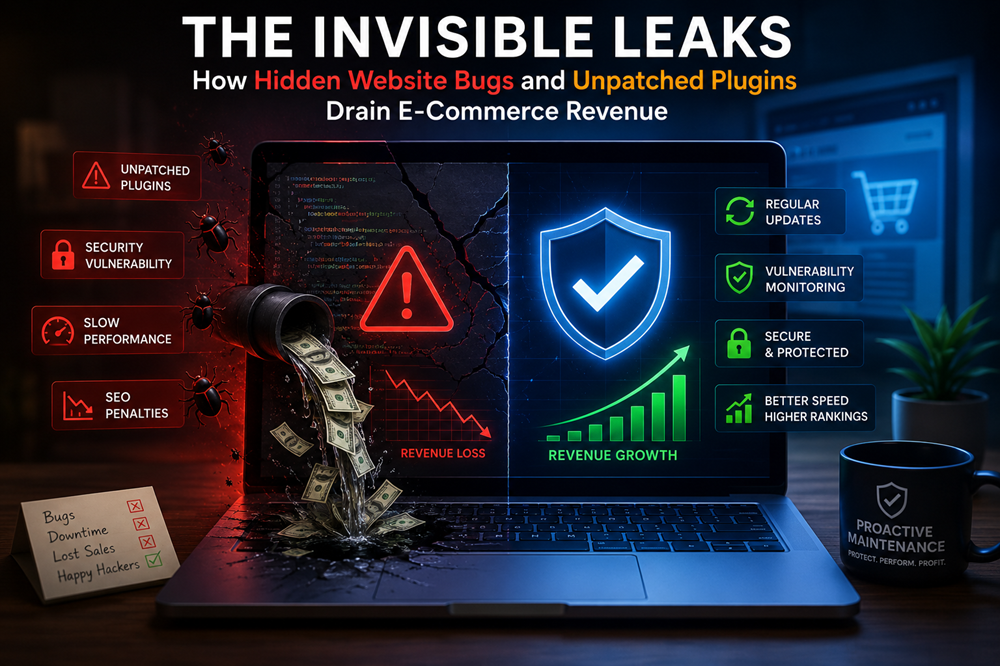

Think of a website as your store, where the main code of platforms like Shopify or WordPress serves as its building block. Plugins act as internal assets, such as your POS system, security tools, and networking equipment. When a developer writes a plugin, they might not realize they have left a tiny crack in the code. A hacker, constantly scanning weaknesses, spots this opportunity to create a “key” that drains vital information. If you underestimate or delay updating that plugin, you are essentially leaving the door open for that scammer.
The “Silent” Consequences
Let’s dive into these consequences of having bugs on a website.
- Performance Decay
A bug in a plugin often loops in the background, suffocating your server. It consumes its brainpower, causing your site to load slowly. The result? Studies prove that users rarely wait to explore a site for longer than three seconds. Even for those who do wait, every single second of delay results in a 7% reduction in conversions. Let’s simplify this: if your online store makes $1,000 a day, a slow plugin could penalize you by costing you $70 every single day. While you may not see the theft happening, your revenue is quietly draining.
- SEO Penalties
Google strives to prioritize user experience. Simply put, the leading search engine wants to send its users to safe, fast sites. If your e-commerce store remains unpatched—whether due to malware or just a tiny piece of buggy code—it becomes a red flag for Google. It may label your store as “Deceptive,” which means it will stop ranking your website in top searches and effectively turn off your online exposure.
This unfortunate situation can be reversed by delegating maintenance tasks to a professional. While focusing on marketing can attract short-term traffic, outsourcing technical updates is the best strategy for long-term retention. It handles the debugging of your e-commerce store and prevents checkout errors that typically break user trust.
The Power of Professional Maintenance
What if you have multiple plugins that all need updates? Handling this manually can be overwhelming. This is why many updates remain pending for far too long. Most online sellers are not web developers or coders; they are experts at marketing, content creation, and generating profits. These updates and technical requirements demand regularity and expertise to understand what to do when one update conflicts with another. Otherwise, the whole store breaks, leading to what is technically known as the “white screen of death.”
This is where the idea of outsourcing regular technical updates to handle platform-specific bugs proves to be a groundbreaking experience. Delegating this task to a professional is a strategic decision. Here is what store owners should expect:
- Staging Environments: A professional outsourcing company never updates a live store directly. Before making any changes, expert developers clone your website into a “sandbox”, which is a private test room. There, they run the updates to ensure everything is working perfectly before the changes go live.
- Vulnerability Monitoring: Experts use specialized tools that notify them the very second a security vulnerability is announced for any plugin on your website. This is the best part—they don’t wait for you to notice a problem. Instead, their certified teams patch the hole before hackers can even find their way in.
- Conflict Resolution: Sometimes, two plugins are not compatible, and their conflict is not easy to resolve. By hiring an expert, you ensure that someone knows exactly how to tweak the code to make them play nicely together. Once done, your e-commerce store stays fast and functional.
The True Cost of Neglect
E-commerce merchants must look at the total cost of ownership. Generally, people believe they can handle maintenance themselves to save money. But what if you, as an e-retailer, spend three hours a week debugging? Those are precious hours that you are not investing in innovation or addressing customer needs. This practice ultimately results in losses.
- The Hidden Math
If your store generates $500,000 in annual revenue, a 3% loss of fraud equates to $15,000. This figure does not even account for how much you have lost to slow loading times and diminished SEO performance. This loss can easily double if you keep your eyes closed to the technical side of your business. Over time, you will discover that your web ranking in search results has plummeted due to these neglected issues.
- The Investment
Outsourcing technical assistance is highly affordable because it costs only a small fraction of your potential losses. You aren’t just spending money; you are investing in an insurance policy. Beyond preventing losses, it helps you anticipate prospective risks and resolve them long before they escalate.
Why Vigilance Wins
The digital world remains relentlessly active. Even when you are sleeping, automated bots and robot programs continue to crawl into your website. These monitoring bots test your site and discover weaknesses without telling anyone. If you don’t have programs or professionals to track everything, you are simply relying on luck. Certainly, “luck” is not a business strategy in the competitive world of e-commerce.
So, you must stay updated, either through your own rigorous schedule or by hiring professional web developers who handle the technical heavy lifting like a champ. In essence, these professionals help your e-commerce platform transition from an easy, vulnerable target into a digital fortress. Overall, outsourcing is not just about updating software; it is about protecting your dream and ensuring that every customer visiting your store has a safe, fast, and happy experience. That is how you turn a small store into a massive e-commerce empire.
Conclusion
Research indicates that global fraud losses reached $48 billion in 2025 (Juniper Research), which is an alarming reality. It serves as a red flag for those who delay plugin updates or debugging. Mastercard has revealed that merchants lose, on average, roughly 3% of their total revenue to fraud. Consequently, it is vital to perform updates proactively to prevent long downtimes, which can cost millions of dollars per hour. Outsourcing remains the best alternative to prevent these hassles and manage your store as a professional.